You found a wrap you love on Instagram, saved it three times, and now you're ready to pull the trigger on a car wrap color change. But here is where most people hit their first snag: they walk into a shop thinking this is one decision when it is actually three. You need to pick the right finish for your lifestyle, choose a film brand that will actually last, and find an installer who knows what they are doing. Get any one of those wrong and you are looking at peeling edges, fading color, or a finish that looks great for six months before it starts to embarrass you.
This guide is built to walk you through all three decisions from the beginning. You will learn the difference between gloss, matte, satin, and color-shift finishes, understand what separates budget film from premium film, and know exactly what questions to ask before handing over your keys. By the end, you will have everything you need to shop with confidence and avoid the regrets that send people back to the shop before they should be.
Why a Color-Change Wrap Is Really Three Decisions in One
Most people shopping for a color-change wrap start with one question: "What color do I want?" That's the fun part. But color is only one piece of a three-part decision, and the other two parts are just as likely to determine whether you love the result or regret it.
The three decisions are finish type, film brand, and installer quality. They stack on each other in a specific way. The finish you choose dictates how you'll care for the car going forward. The film brand determines how long that finish holds up. The installer determines whether any of that matters, because the best film fails fast if surface prep and application are wrong.
Done right, a color-change wrap lasts three to five years with proper care and comes off cleanly without touching the factory paint. Done wrong, it can bubble, peel, or damage the paint within months.
This guide walks through each decision in order so you can walk into any shop, or request a quote from Wrapt Auto, already knowing what to ask. If you have questions along the way, the FAQ on our color change wraps page is a good reference. Whether you're looking at a 3M vinyl car wrap, an Avery Dennison film, or a color-shift finish, the same framework applies.
The Five Finish Types You'll Actually Encounter
So let's start with the first real decision: what the car actually looks like.
There are five finish categories you'll run into when shopping a color change wrap.
Gloss is the most familiar. It mirrors factory paint closely, with sharp reflections and high shine. If you've ever admired a freshly washed car under showroom lights, that's gloss. It's the default choice for a reason.
Matte is the opposite. It absorbs light instead of bouncing it back, producing a completely flat, raw look that reads more aggressive than anything gloss can deliver. Because it eliminates reflections, it actually makes body lines and panel curves more visible, not less. It turns heads because it's still genuinely uncommon on public roads.
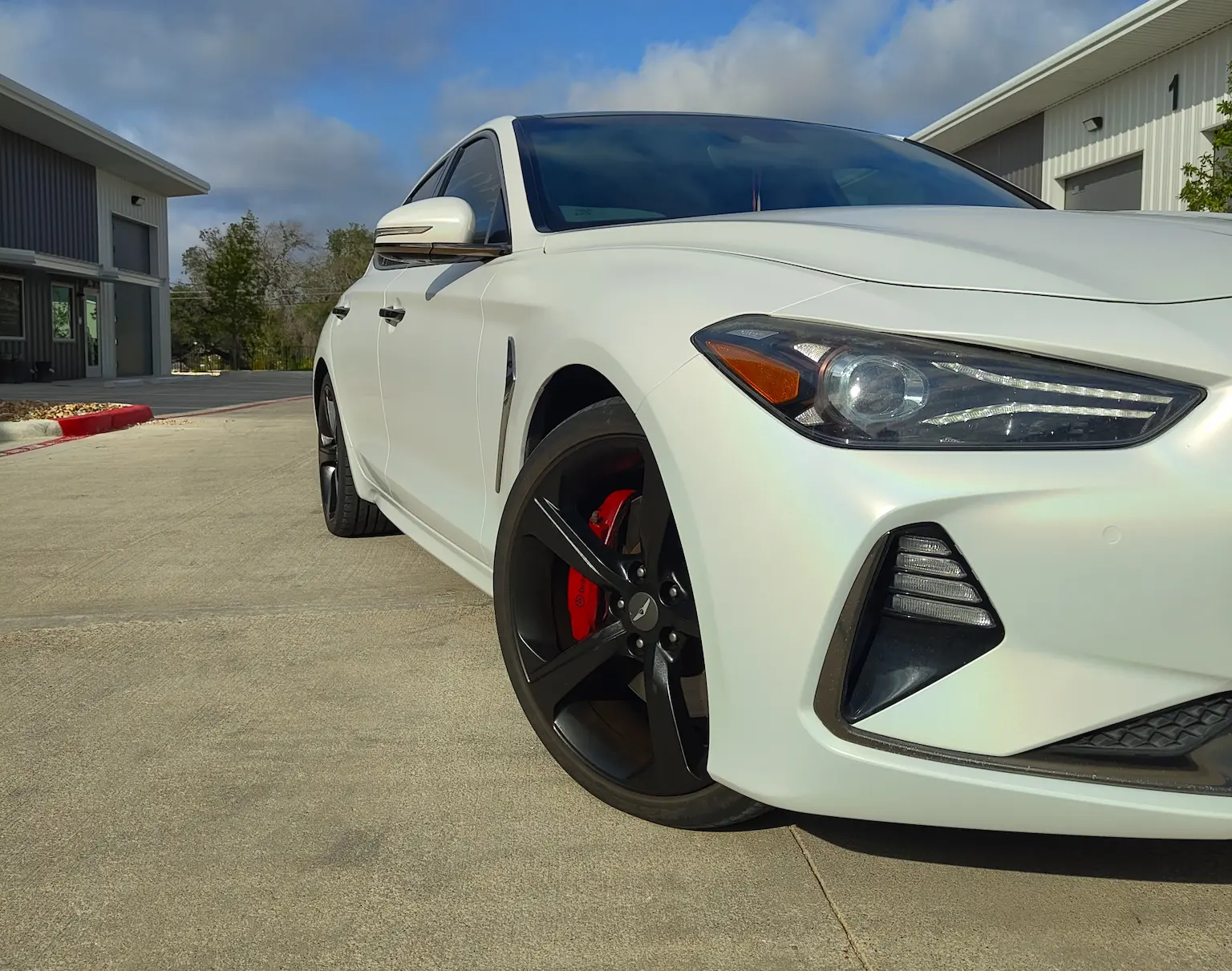
Satin sits right between the two: a soft, diffused sheen that looks premium without the demanding upkeep of true matte. It's the most popular finish at our shop, and it's earned that spot by combining the best qualities of both without the worst trade-offs of either.
Metallic and color-shift films (also called chameleon or flip films) use a multi-layer construction that shifts hue as the viewing angle changes. Color-shift paint exists too, but it's an expensive, permanent custom paint job. Film gets you the effect and comes off when you're done with it.
Textured finishes like brushed aluminum or carbon fiber add a physical dimension to the surface. These are used most often as accent panels rather than full wraps, and they pair well against a contrasting base color for a custom look.
Each finish has its own maintenance reality. That's next.
Gloss: The Familiar Choice That Is Easiest to Live With
Of all the finish types, gloss needs the least explanation. It looks like paint, and most people already know how to care for paint. That familiarity makes it a smart starting point for a lot of buyers.
Maintenance is as simple as it gets. Gloss vinyl works with regular pH-neutral car wash soap and microfiber towels, no specialty product cabinet required. The one change from paint: skip wax, which dries vinyl out over time. A vinyl-safe ceramic coating is the better way to add protection.
The honest trade-off: gloss shows dust and fingerprints at roughly the same level as painted metal, and swirl marks from aggressive washing show up under direct light. Neither is a dealbreaker, but both are worth knowing upfront.
Lifestyle fit matters more than aesthetics. Gloss is the right call if you hand wash with pH-neutral soap, park outside daily, or just don't want to rethink your cleaning routine after a wrap.
It's also the safest pick if you plan to sell the vehicle. A buyer who knows nothing about wraps will read a gloss finish the same way they'd read paint, keeping resale conversations simple. For more on how the other finishes compare day-to-day, see our matte vs. gloss wrap guide, which also covers satin.
Matte: The High-Impact Finish That Demands More From You
Matte film absorbs light instead of bouncing it back, producing a flat, almost raw look that turns heads because you genuinely don't see it often on public roads. That rarity is half the appeal. The other half is what it does to body lines: without gloss reflections competing for attention, curves and sculpted panels read more cleanly and dramatically. On a car with strong body styling, matte makes those lines pop in a way gloss simply can't.
The tradeoff is maintenance, and it's a real one. Standard wax is incompatible with matte film, applying it can permanently alter the flat finish in ways that are difficult or impossible to reverse. Only matte-safe detailing products should touch the surface. Dust and fingerprints are noticeably visible, especially on dark colors. Bird droppings and road tar need to come off quickly, matte film is unforgiving about contaminants left to sit.
Matte is the right call if you hand wash, detail regularly, and garage the car most of the time. It's the wrong call if the car lives outside. And whatever finish you pick, stay away from brush car washes. Brushes scratch every wrap finish, while touchless automatic washes are fine.
If you're weighing matte against a protective option, our color PPF vs. wrap comparison covers how color PPF stacks up for high-maintenance finishes.
Satin: Why It's the Most Popular Finish at Our Shop
If matte is the high-effort, high-reward option, satin is what most people actually want once they think it through.
Satin sits between gloss and matte, giving you a soft, diffused sheen that reads unmistakably premium without the dedicated care routine matte requires. It looks noticeably different from factory paint, which is exactly what a color change wrap should do, but it does not punish you for washing the car on a Saturday morning without a specialty kit.
The maintenance reality is genuinely forgiving. Satin can show fingerprints, but it won't stain the way matte can, and it's easy to clean. Swirl marks from washing are nearly invisible. Use satin-safe wash products and a film-safe detailing spray; skip standard wax. That is the full list of restrictions. There is no long inventory of things that will ruin the finish the way there is with matte.
Satin also translates across virtually every vehicle body style. Trucks, SUVs, sports cars, daily sedans, it works on all of them. That versatility is a big part of why satin is the finish our customers choose most.
If you want a finish that looks great, holds up to real life, and does not require you to change how you care for the car, satin is consistently where customers end up most satisfied.
Metallic and Color-Shift Wraps: Standout Finishes Without a Custom Paint Job
Metallic and color-shift films give you the kind of finish that would otherwise take a high-end custom paint job.
Metallic vinyl embeds metal flake directly into the film layer, producing depth and sparkle that shifts as light moves across the surface. Color-shift films (also called chameleon or flip films) use a multi-layer construction that produces a full hue transition as your viewing angle changes, an effect that in paint takes a specialty custom job.
Both finishes cost more than gloss or satin, and installation demands more precision. The visual effect amplifies any mistake; a poorly stretched panel or misaligned seam is immediately obvious in a way it isn't on flat gloss. Specialty films are one of the bigger price variables, and our specialty finishes cost breakdown has the numbers.
For maintenance, treat them similarly to satin. Standard wax can dull the metallic layer, so stick to film-safe ceramic coatings or spray detailers designed for vinyl.
These finishes reward vehicles with clean, flowing body lines. On cars with simpler body lines, accent panels in a metallic or flip film paired against a contrasting base color can be just as effective.
How to Match Your Finish to Your Actual Lifestyle (Not Your Dream Lifestyle)
Knowing what each finish looks like is the easy part. The harder question is which one you'll actually be happy with six months after the install.
The most common source of wrap regret is picking a finish based on photos without thinking through what maintaining it looks like on a random Tuesday morning when you just need to get to work.
Before you commit, answer four honest questions: How often do you actually wash the car? Where does it park most days, a garage, street, or open lot? Do you detail it yourself or drop it off somewhere? Are you keeping the vehicle long-term or selling within a few years?
Those answers matter more than the photos. If your car sits outside daily in a high-UV climate, matte shows environmental buildup more visibly and needs more frequent attention than other finishes. You can read more about how climate and care affect wrap longevity in how long a car wrap lasts in Texas.
If you rely on brush-style tunnel washes, no wrap finish is a good fit. The brushes scratch matte, satin, and gloss alike. Touchless automatic washes are fine for any finish, so switch to touchless or hand washing before you wrap.
As covered in the finish sections above, gloss needs the least upkeep, satin balances looks with livability, and matte or color-shift reward the committed detailer.
Film Brand Tiers: What You Actually Get When You Pay More
Once you've matched a finish to your lifestyle, the next question is what that finish is printed on, and this is where a lot of buyers get burned.
Not all vinyl films are created equal. The gap between a budget roll and a premium film shows up in four ways: how well it stretches around curves, how cleanly the adhesive releases at removal, how long the warranty lasts, and whether that warranty means anything.
At Wrapt, we install film brands we trust: 3M, Avery Dennison, KPMF, and Orafol. These four are the standard in professional shops because they have documented performance histories and real manufacturer warranties.
Conformability is the spec that matters most during installation. Premium films use a cast construction that stretches around door handles, mirror housings, and recessed panels without lifting. Budget films are typically calendered, thicker and stiffer than cast film, and they fight the installer on every curve.
The removal risk is the part nobody talks about upfront. A poor adhesive can pull clearcoat or leave residue, turning a simple removal into a paint correction job.
A shop using unbranded film can only offer a labor guarantee. A shop using 3M, Avery Dennison, KPMF, or Orafol can hand you printed manufacturer documentation. Ask for it.
Cast vs. Calendered Film: The Spec That Affects How Long Your Wrap Lasts
There are two ways vinyl film gets made, and the difference shows up years later on your car.
In conventional wrap industry terminology, cast film refers to film produced by a process where a liquid vinyl formula is poured onto a casting sheet and cured slowly. That slow cure leaves the film dimensionally stable, with a natural memory that resists shrinkage and lets it conform smoothly around curves, recesses, and compound body panels.
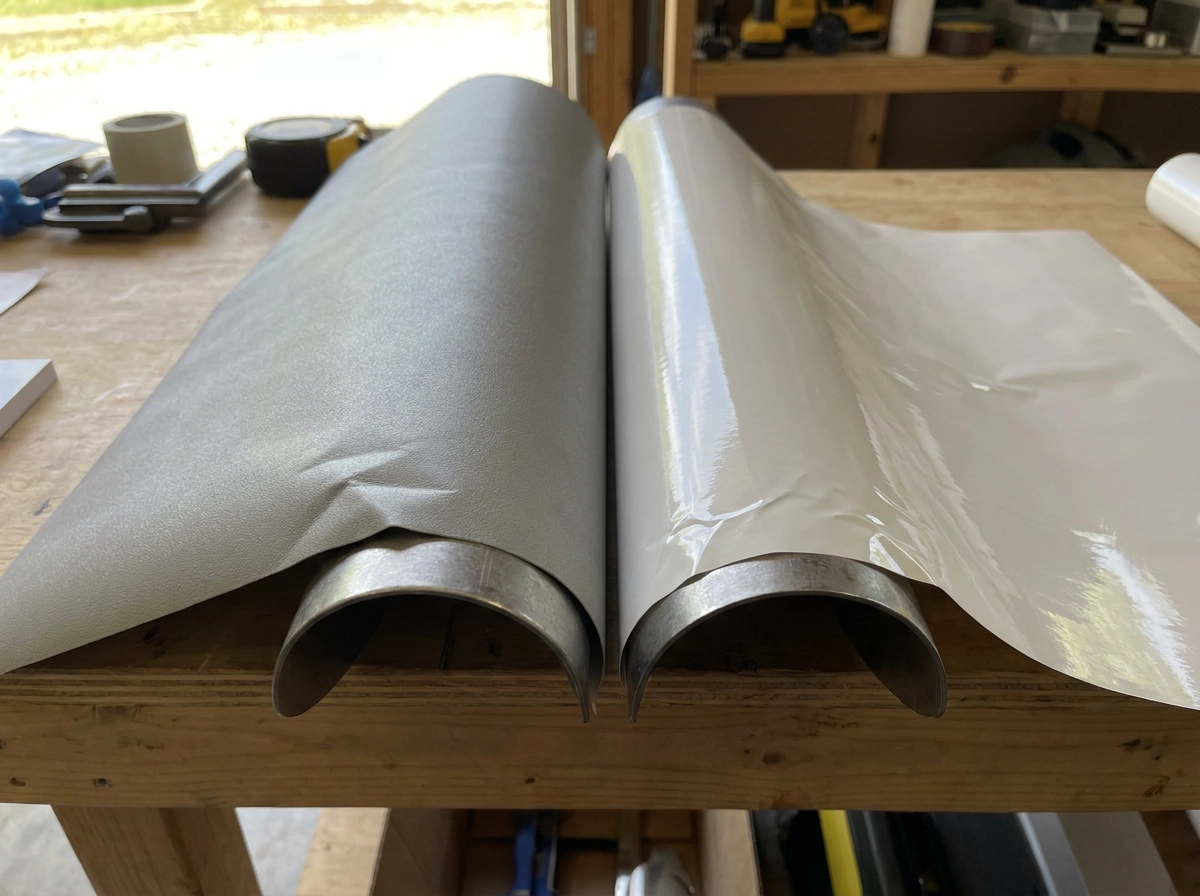
Calendered film is made by pushing vinyl through heavy rollers under pressure. The result is thicker and stiffer, holding internal stress from the manufacturing process. In heat, that stress releases as shrinkage. On flat signage, that is fine. On a door handle recess or a hood edge, it means lifting.
For a full color change wrap on any modern vehicle, cast film is the only right answer. Calendered film on complex panels tends to show early edge-lift and shrinkage problems sooner than cast film, often well before cast-film lifespans are reached.
3M, Avery Dennison, KPMF, and Orafol all offer cast-grade films for vehicle applications, and a shop that cannot tell you which type they use is a red flag worth taking seriously.
What to Ask About Film Brand and Warranty Before You Commit
Now that you know cast film is the right spec, the next question is which cast film, and that's where brand and product line actually matter.
Don't let a shop answer "what film do you use?" with just a brand name. 3M, Avery Dennison, KPMF, and Orafol each have multiple product lines at different quality and warranty tiers. "We use 3M" tells you almost nothing. Ask for the specific series name.
Then ask what the warranty covers and for how long. Manufacturer warranties on premium cast film cover defects in the film itself, like cracking, fading, bubbling, or peeling. They don't cover normal wear, scratches, or paint that pulls up during removal, and coverage is shorter on horizontal surfaces like the hood and roof than on the sides. Terms vary by product line, so get them in writing, not just a verbal assurance.
Ask whether the warranty is from the manufacturer, the installer, or both. Those are two different things. At Wrapt, every film we install carries a manufacturer warranty, and we back every installation with our own 12-month craftsmanship warranty on top of it. Some manufacturers only honor their warranty when a certified installer applies the film, so ask about certification too.
If you're going with a specialty finish like color-shift or a textured film, ask specifically whether that finish is covered the same way. Some warranties treat specialty films differently.
If a shop responds to any of these questions with something like "we use quality materials," that's not an answer. Push for specifics, or start looking at other shops.
Tell us your make, model, and what you have in mind. We'll give you an exact quote, not a ballpark.
How to Vet an Installer Before You Hand Over Your Keys
Knowing what film to ask for gets you halfway there. The other half is making sure the installer actually knows what they're doing.
Premium film installed poorly will still bubble, lift, and peel. The film doesn't save a bad install.
Price is the wrong filter. Two shops can quote the same number with completely different processes behind it. One runs a full decontamination wash, wipes every panel with IPA, and works in a climate-controlled bay. The other power-washes the car and gets started. Same price. Very different results.
The three things that separate a professional install from a bad one are surface prep, application environment, and edge finishing. Ask about all three before you book. Later sections go deeper on each, but raise these in your first conversation with any shop.
On portfolio: ask to see past work on jobs that show some age. Surface prep failures and lifting edges don't always show up in the first few weeks. Fresh work looks fine even when the process was wrong.
Pay attention to how a shop answers your questions. A confident installer will walk you through their process without hesitation. If you ask "how do you prep the surface?" and get a vague answer or a subject change, that tells you everything you need to know.
Surface Prep: The Step That Determines Whether Your Wrap Sticks
Surface prep is where the money either gets protected or wasted. It's also the step that separates shops doing this right from shops cutting corners to save time.
A proper prep starts with a full decontamination wash, not just a rinse and soap. That means removing iron particles, tar, and wax or sealant residue from the paint surface. Regular washing won't get all of that off.
Here's why wax matters so much: any wax or coating left on the paint acts like a release agent under the film adhesive. The film can't bond to a slick surface. It may look fine the day it's installed, then start lifting at edges and panel recesses within a few months.
After the decon wash, every panel gets wiped down with isopropyl alcohol or a dedicated prep solution before film goes down. This removes whatever the wash missed. Skipping this wipe-down is one of the most common shortcuts budget installers take.
Paint condition is also part of prep. Deep scratches, rock chips, and oxidation should be addressed before the film goes on. A good installer flags those issues upfront, not after the job is done.
So ask directly: "Walk me through your surface prep process." A solid answer sounds like: decon wash, clay bar or iron remover, IPA wipe-down. A vague answer is your cue to keep looking.
Application Environment: Why a Controlled Space Matters
Surface prep gets the paint ready. The application environment is what keeps it clean while the film goes on.
Vinyl film is temperature-sensitive. Most premium films need ambient temps between roughly 50 and 90 degrees Fahrenheit to apply correctly, with manufacturers often recommending a tighter target of around 65–75°F. Too cold and the film stiffens, loses flexibility, and can crack when stretched around curves. Too hot and the pressure-sensitive adhesive activates before the installer is ready, causing the film to grab prematurely and making repositioning nearly impossible.
A professional shop installs in a climate-controlled, enclosed bay. No wind, no direct sunlight, no open garage doors. Applying film outdoors or in an uncontrolled space is a shortcut that shows up as contamination under the film or uneven adhesion across panels.
Dust is the other enemy. A single airborne particle trapped under the film creates a visible bump under direct light, and the only fix is pulling that section back and starting over. A clean, sealed bay eliminates that risk. Humidity is a secondary factor with some adhesive systems, and a proper shop accounts for it rather than gambling on the weather that day.
At Wrapt, every wrap goes on inside a fully enclosed, air-conditioned shop with air filtration, so temperature and dust are controlled from the first panel to the last. When you visit for a quote, look at the bay itself. Clean, enclosed, well-lit? That's a professional setup. Crowded, open, or partially outdoors? That's not where a multi-thousand dollar wrap should be installed.
Edge Finishing and Seams: Where Most Wraps Eventually Fail
Even a perfect application environment means nothing if the edges and seams aren't handled correctly, because that's exactly where wraps fail first.
Door edges, hood lips, trunk edges, and mirror housings take the most punishment. Airflow at highway speeds, repeated temperature swings, and daily open-and-close cycles all stress the same spots. Lifting almost always starts there, not in the middle of a flat panel.
A professional installer doesn't stop the film at the visible edge of a panel. They wrap it around door edges, behind trim pieces, and around panel lips so the adhesive is anchored against a protected surface. A wrapped edge holds significantly longer than a cut edge left exposed to airflow.
Seam placement is just as important. Seams that run along body lines or are tucked into low-visibility areas stay put and stay invisible. Seams across flat panels catch air and catch eyes, both of which you want to avoid.
Before you book, ask how the shop handles door jambs. Wrapping jambs properly takes extra film and a lot of extra labor, so a good shop prices them as an add-on. At Wrapt, door jambs are always quoted separately. If a quote says jambs are included at no extra cost, ask exactly what's getting wrapped.
Finally, post-install heat work matters. A heat gun or infrared lamp pushed over every edge activates the adhesive fully and eliminates the vinyl's memory. Skip that step, and edge lifting within the first year is a common result.
Red Flags and Green Flags When Comparing Wrap Shops
Knowing what a professional install looks like is only useful if you can spot the difference when you're standing in a shop. Here's a quick filter.
Green flags:
- The shop names the specific film brand and product line without hesitation, explains why they chose it, and hands you printed warranty documentation. "We use 3M 2080 cast film, here's the warranty card" is the answer you want.
- Their prep process comes up voluntarily before you even ask, a sign that surface decontamination and IPA wipe-down are standard practice, not an afterthought.
- They flag existing paint issues they found on your vehicle during the consultation. A shop that notices and mentions a chip or scratch before the job starts is a shop that's paying attention.
- They offer a written workmanship warranty alongside the manufacturer film warranty, and can explain clearly what each one covers and for how long. Two separate documents, two separate coverages.
Red flags:
- The quote is significantly lower than every other estimate with no explanation. Cheaper quotes almost always mean less film coverage, lower-grade materials, or skipped prep steps. Something is getting cut.
- They can't show you completed work on vehicles similar to yours in age and body complexity. A late-model car with sculpted body lines is a different job than a flat cargo van.
- Vague answers to direct process questions. "We wash it really well" is not a prep process. That's deflection.
What a Color-Change Wrap Actually Costs and What Moves the Price
Once you know how to spot a quality shop, the next question is usually: "What should I actually expect to pay?"
Color change wraps are quoted as one price for the whole vehicle, not by the square foot. Gloss, matte, and satin all start at roughly the same baseline. At Wrapt, a full color change wrap on a sedan starts at $3,200 whichever of the three you choose. The finish type itself is not what drives the number up.
What actually moves the price:
- Vehicle size and body complexity. A compact sedan takes less film and less labor than a full-size truck or SUV with complex body lines.
- Specialty finishes. Color-shift and metallic films cost more than standard finishes, so a full color-change wrap in either will run higher than the same job in gloss or satin.
- Coverage scope. Full wrap versus partial wrap is a significant cost difference. Door jambs are an add-on at any good shop, because doing them right takes extra film and a lot of extra labor.
- Film brand. A full wrap in a premium 3M or Avery Dennison cast film costs more than the same job in an unbranded film. That gap is real and earned, through warranty coverage, proper conformability, and clean removal years down the road.
- Installer experience and market. A proven shop with real overhead, a quality-controlled process, and warranty support will price accordingly. That is not a red flag; that is what professional work costs.
Get at least three quotes, compare what each includes, and pay attention to how each shop answers your process questions. The goal is not the lowest number; it is the best value from a shop that can back up what they are charging.
Wrap vs. Paint: When a Color Change Wrap Makes More Sense
Once you've settled on a budget, it's worth stepping back and asking whether a wrap is even the right move versus a full repaint. For most people, it is, and here's why.
A quality respray can cost significantly more than a premium wrap, and it's permanent. The factory color is gone. A wrap is reversible. The original paint stays protected underneath, and on healthy factory paint, a wrap removed within its lifespan comes off without damage. Repainted panels, or paint that was already chipped or failing, can lift with the film, so tell your installer about any past bodywork.
If you're leasing, repainting isn't a practical option. A wrap avoids that problem, since it can come off before you turn the car in.
Resale is another angle worth considering. A car repainted in an unconventional color can be a harder sell because buyers discount non-factory work. A wrapped car can be unwrapped to show clean original paint, which most buyers see as a neutral or a positive.
Wraps also make some looks far easier than paint. Partial color changes, two-tone designs, and color-shift finishes can all be done in paint, but there they're expensive and permanent. With a wrap, they're reversible.
The bottom line: if you want a color change you might reverse someday, a wrap protects the paint while it's on and gives you options a respray permanently closes off.
The Short Version: How to Get Your Color-Change Wrap Right
Once you've worked through the decisions in this guide, the path forward is pretty straightforward. Here's the short version.
Match your finish to how you actually treat your car, not how it looks on someone else's feed. As covered in the finish sections above, gloss needs the least upkeep, satin balances looks with livability, and matte or color-shift reward the committed detailer.
Ask for the specific film product line, not just the brand name, as detailed in the warranty section, any reputable shop should hand you documentation to back it up.
Vet the installer on process, not just price, the prep and environment sections above cover exactly what confident, specific answers look like.
When comparing quotes, look at what's included. The cheapest number rarely reflects the full picture.
At Wrapt Auto in Austin, we use 3M, Avery Dennison, KPMF, and Orafol films and back every installation with a 12-month craftsmanship warranty. We're happy to walk you through everything before you commit. Request a free quote and we'll get back to you within one business day.
Conclusion
A color-change wrap done right comes down to three things: a finish that fits your real lifestyle, a film brand with documented quality and warranty backing, and an installer who can answer hard questions with confidence and specifics.
Get those three right and you end up with a result that looks exceptional, lasts years, and protects the paint underneath. Get even one of them wrong and you're paying to fix it sooner than you should.
You now have everything you need to make an informed decision, ask the right questions, and spot the difference between a shop worth trusting and one worth walking away from.
At Wrapt Auto in Austin, we're ready to walk you through your options at no pressure. Request a free quote today and get a response within one business day. Your next color starts here.
Frequently Asked Questions
How long does a color-change wrap last if installed correctly?
A properly installed color-change wrap on a well-prepped surface should last three to five years. This lifespan depends on three key factors: using cast film (not calendered), choosing a reputable film brand like 3M, Avery Dennison, or KPMF, and having an installer who follows proper surface prep and application procedures. Done wrong, a wrap can bubble, peel, or damage the paint within months.
What's the difference between cast and calendered vinyl film?
Cast film is produced by pouring liquid vinyl onto a casting sheet and curing it slowly, resulting in a dimensionally stable film that resists shrinkage and conforms smoothly around curves. Calendered film is made by pushing vinyl through heavy rollers, creating a thicker, stiffer material that holds manufacturing stress. In heat, calendered film releases this stress as shrinkage, causing edge-lift problems. For full color-change wraps, cast film is the only right choice for modern vehicles.
Which finish is easiest to maintain?
Gloss is the easiest to maintain, requiring only regular pH-neutral car wash soap and microfiber towels. Satin is the most popular choice in 2026 because it balances ease of care with premium appearance, dust and fingerprints show less than on gloss or matte, and swirl marks are nearly invisible. Matte requires the most maintenance, as standard wax can permanently alter the finish, and contaminants like bird droppings must be removed quickly.
Should I get a wrap or a full repaint for a color change?
A wrap is typically the better choice because it's fully reversible, the original factory paint stays protected underneath and you can remove the wrap cleanly anytime. A full repaint is permanent and more expensive. Wraps also offer advantages for leased vehicles (no lease-end complications), resale value (buyers can see original paint underneath), and design flexibility (partial wraps, two-tone designs, and color-shift effects aren't possible with paint).
What are the red flags I should watch for when choosing a wrap shop?
Watch out for: (1) quotes significantly lower than competitors with no explanation, something is being cut, whether it's prep steps, material quality, or coverage; (2) shops that can't show completed work on similar vehicles; (3) vague answers to direct process questions like 'How do you prep the surface?'; (4) inability to name the specific film product line and warranty terms; (5) reluctance to include door jambs, engine bays, or other details. A reputable shop will answer process questions confidently and provide written warranty documentation.